

Burn
a remembrance of the 2022 Hermit's Peak Calf Canyon Fire

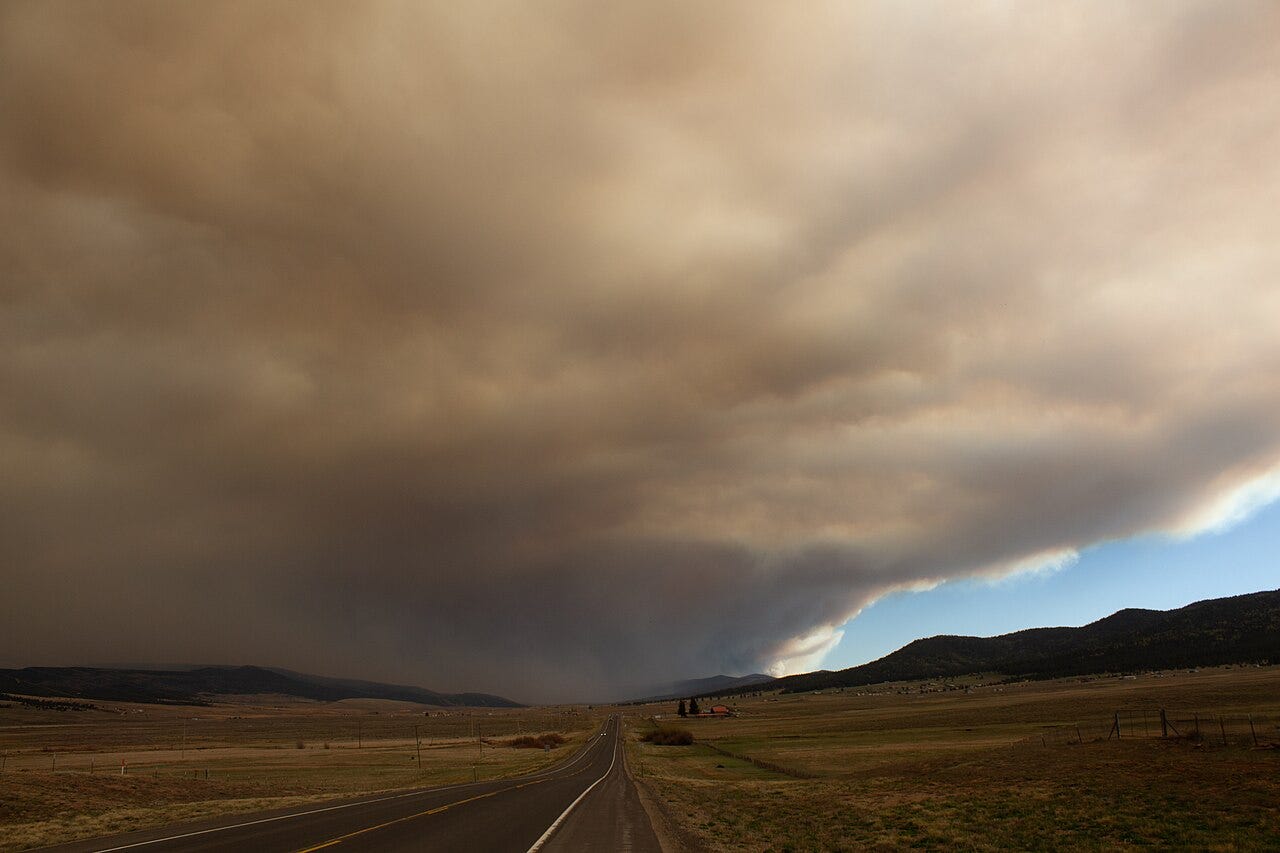
Today’s Postcard is a bit different than usual.
Four years ago, Northern New Mexico was under siege from the worst wildfire in our history. I wrote this essay during the first month of the Hermit’s Peak/Calf Canyon fire. It took three months to fully contain the fire, and more than 340,000 acres of land was burned.
This is not an especially hopeful essay but it reflects the reality of life here, where forest fires are something we live with, and in our changing climate have become more extreme. It was also written at the tail end of the pandemic, so some of that reality is woven in here as well, along with a Buddhist perspective that may help to hold all of it.
I’ll be curious to hear what you think if you read it… please leave a comment if you feel so moved!
May 17, 2022
This morning I woke up to the smell of a campfire and a strange orange light filtering through the shades of my bedroom window. Today is day 41 of the Hermit Peak/Calf Canyon fire, on the east side of the Sangre de Cristos mountain range, about 40 miles from my home as the raven flies.
Originally started as a proscribed burn by the U.S. Forest Service in early April that got out of control, the fires have now consumed more than 260,000 acres. From south to north they spread almost 50 miles, from Las Vegas, New Mexico, to the southern part of Taos County.
These fires are hellish monsters burning far beyond our capacity to control them.
As I drove down my road toward the main highway a few days ago, I was stunned to see a massive mushroom cloud billowing over the mountains in front of me. My home is not far from Los Alamos National Laboratory (LANL), where radioactive elements for nuclear weapons are manufactured, and it wasn’t a stretch to wonder if some horrific atomic disaster had occurred. I had to pull over for a moment to regain my composure before I could keep driving. Later I learned this was a pyrocumulonimbus cloud, generated under conditions of extreme heat such as volcanic eruptions -- and these fires.
Another fire has started burning to the west in the Jemez mountains, coming precariously close to LANL. Here in the Española Valley we’re in a fire sandwich between the Hermit Peak/Calf Canyon fire to the east and the Cerro Pelado fire to the west.
A few weeks ago I was staying at a friend’s house in Santa Fe. One afternoon the smoke was so bad we couldn’t stay outside more than five minutes. I felt the particulates lodging in my lungs and couldn’t see more than about 50 feet in front of us. The Air Quality Index score that day was 250 pp, in the “very unhealthy” zone.
Something felt eerily familiar about the scenario. Then I realized this constant yellowish brown haze was the sky I grew up with in 1960s Los Angeles before vehicle emissions were monitored and regulated. I never realized how blue the sky could be until I was about 8, the first time I went with my cousin up to Big Bear one winter. We drove out of the smog-filled LA basin into the mountains and blue sky of the San Bernardino National Forest. That same brilliant hue of blue was the sky I fell in love with when I first visited New Mexico many years ago, and one of the big factors that called me to move here. Right now those blue skies have completely disappeared.
The winds this month have been harrowing, more than is right for May and more sustained than I remember in my relatively short 14 years of living here. While April can be volatile, by May the weather usually settles into the calmness of spring. Old timers say the same thing. In a typical April and May, this part of New Mexico averages one to two inches of rain each month.
This spring we’ve gone more than 40 days without any measurable precipitation. The past week, winds have regularly raged 40- to 50-miles-per-hour. Every day “red flag warnings” let us know that this combination of extreme winds, heat, and dryness have created tinderbox conditions. Even a spark from a car moving over dry grass could trigger another fire.
With fires come regeneration and renewal, at least that’s how it has been in the past. But something is very different with these weather patterns and wildfires. Nothing about this feels natural. Some ecologists speculate that the vast and verdant ponderosa pine forests now burning on those mountainsides and meadows will not return. It’s likely the vegetation will be forever transformed into clusters of shrub thickets, exotic grasses, and scrub oaks.
The burning areas are home to traditional Native/Hispanic villages. For centuries the people of villages like Mora, Ledoux, and Gallinas have survived on subsistence farming and forestry, and on an ethos of helping each other.
The area is threaded together with a network of communally managed acequias, irrigation ditches that have their origins in Moorish Spain as well as with the Indigenous people of this area who knew how to cultivate crops for food even in arid conditions. In a way that few others parts of the United States can claim, save perhaps the Bayou regions of Louisiana, the people of San Miguel and Mora Counties have an unbroken connection with many generations of cultural and agricultural traditions. Thousands are now displaced by these fires and being re-located as far away as Albuquerque to stay in urban hotels until the fate of their homes becomes clear. There will be no going back to the life they had.
I’ve always assumed redemption and regeneration come after a cycle of devastation and destruction. Now I question: What if they don’t? What does that mean?
It’s like trying to imagine what it would be like one day if the sun doesn’t rise. Life as we know it would cease to exist.
That is death, a permanent ending, at least from the perspective of these temporal, physical bodies. I have no idea what comes beyond that kind of death. This past year I’ve been exploring what it means to have a relationship with my loved ones who have left their physical bodies, and I’ve discovered that it’s entirely possible to stay in relationship beyond death. But I am talking here of endings of humans and eco-systems on a massive scale: from COVID deaths, from climate crisis disasters like fires and hurricanes and tornadoes, from food shortage, from violence, possibly even nuclear attacks. All of it is on the table right now in a way that’s more tangible and real than ever before in my lifetime. I can’t find any relief or regeneration in that. I am not sure any of us can.
Along with everyone I know, I am mentally, emotionally, and physically exhausted by living in a continual cauldron of wildfires, climate crisis, pandemic, white supremacist violence, poverty and desperation, healthcare inequities, as well as processing through my own personal grief from losing three beloveds to death in the past year. It feels like life in a war zone, like there is no escape from any of this and very little time of reprieve before the next cycle sets in.
I feel a trembling in my left bicep, barely perceptible, a subtle wave of fear running through my body. Earlier today a friend texted that she tested positive for COVID. Three days ago I drove her to the airport and spent a few hours with her, without masks. This is the way we have to think these days: Where was I? Who was I with? Did we have masks on? Was there ventilation? Has the other person been vaccinated and boosted? The language of a pandemic, only in this pandemic a lot of people don’t care anymore, or don’t believe it’s a problem, or some combination of the two.
The long shadow of COVID falls on my circle. This virus killed my mom and dad. We are living through a plague that the vast majority seems to be ignoring. After two years of pandemic life and warnings there is only so much we can absorb. I get it. But we are in the territory of mass delusion and denial. Perhaps “only” the most vulnerable are the most at risk. But we are okay with that?
What is that tremor of fear moving through me? What am I afraid of? Annihilation, perhaps, no-more-ness. No-more of what is beloved. As this wildfire rages, so many people in traditional villages that are burning are losing their way of life. I have never met them, I’ve never even been to that region on the east side of the Sangre de Cristos. So why should I care? Maybe because it feels like a symbol of all we’ve lost: the capacity to grow our own food, to tend to the land and to each other, a timeless connection to the earth our ancestors lived on. That’s the warp and weave that kept us together for so long, and now we are losing one little pocket of the Earth where people truly did live like that.
Buddhist teacher and eco-philosopher Joanna Macy talks about this moment in time as the Great Unraveling, the Great Turning. She speaks of the part of every myth where the hero must come face to face with the monster, and not turn away. We are there, this is that time. What courageous and creative response will we conjure up to meet this immense challenge?
For a long time in my early meditation practice, my Zen teacher would observe that I seemed to mostly be in a sea of suffering punctuated by small islands of liberation and freedom. She held out the possibility that over time, as my practice deepened, that ratio could reverse. And indeed that became true.
But in the present context, the ratio feels reversed yet again: back to an ocean of suffering, with small islands of relief. Only it’s not just my personal suffering, it’s a shared experience. It’s incredibly difficult to find equanimity and hope in the midst of all that is unfolding in this Great Falling Apart. I wonder what my ancestors think and feel when they look at what is unfolding in this world that they’ve exited from, these waves of environmental and social collapses.
All I know is that this morning brings yet another round of violent wind gusts, and dry air desiccates the plant life all around me. I’ve taken it on as my task to go outside to my small garden and set up a protective tent with two chairs and a sheet to serve as a windbreak for the zucchinis I put in the ground a few weeks ago. The plants have looked traumatized. It’s become my daily ritual, my act of offering some kind of protection to these plant beings who in turn offer their fruits as food for us. Whether I can save them from these extreme conditions is an open question. But it feels like an imperative to try, to offer even the simplest kind of refuge.

Please consider becoming a paid subscriber of Postcards from New Mexico and receive the following benefits:
• A snail-mail postcard from New Mexico, hand-sent by me!
• A beautiful e-book: “10 Hidden Gems of Northern New Mexico” featuring can’t-miss destinations that most tourists don’t know about
• Access to the “If you go/Local’s tips” section of selected posts where you’ll find valuable information to enhance your next journey here
• A portion of your subscription is donated to Native-led nonprofits
Postcards from New Mexico Bookshelf!
If you’re planning a visit to New Mexico or if you want to learn more about the history and culture of the place, I’ve put together a bookshelf on Bookshop.org, a great alternative to Amazon. Bookshop sales support authors and independent bookstores. I have an affiliate account with Bookshop and if you purchase a book through the links on this page, I receive a small percentage of the sale, so you’re also supporting me and Postcards from New Mexico!
Wow. The experience of living with ongoing loss. It is our great teacher. I reflect often that we can take nothing with us. Our ego is gutted along with all of our physical and mental capacities when we die. Atisha’s 9 contemplations of death have been present the last few days as I prepare to turn 61.
Maia, I felt more of all how different live in Europe is, the longer I engage, the more I read, the more I realize just how different life has become between the US I knew up until 2012 and what I read today. Where I live I cannot remember one wild forest fire in my whole life. We occasionally have some in other parts of Germany, yet they are usually put out within hours. We're I grew we always has blue sky's not much difference, except for the environmental background noise of the planes criss-crossing the sky nowadays. And yes, with each day I am become more and more aware how privileged we are in Europe compared to the U.S. it is beyond comparison. All of this I simply cannot imagine the strain it has to put on the individual and to think it will likely get much worse before it will hopefully at some point get better, and yet which damage by then had been caused, and to have to life it. It needs a lot of inner strength, resilience and courage, I presume. I wish you all of it. Thank you for sharing this account from the past.